
Context-mediated domain adaptation in multi-agent sensemaking systems
EICS 2026
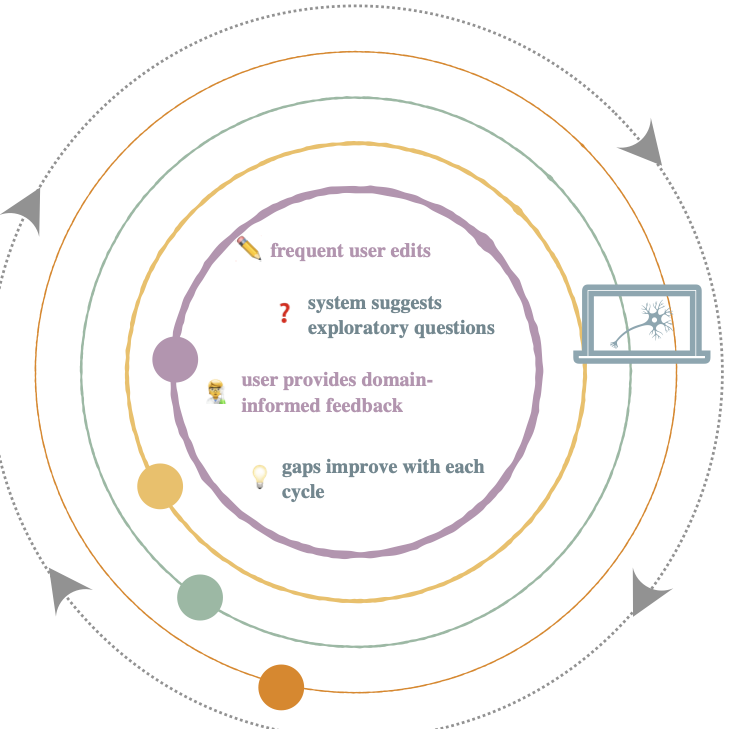
The problem: knowledge that never sticks
Imagine your research assistant never tires and reads every paper overnight, but every morning forgets what's specific to your field: the terminology that must be precise, the methods you trust, and exactly how you want a research question framed.
That is 2025's LLM agent. Every new session is a cold start that repeats yesterday's mistakes.
-
Train implicitly, manage explicitly
Learn domain knowledge from ordinary use, yet keep it inspectable and editable
-
Externalize the knowledge
Persistent, scalable data structure that can be shared and reused.
What if the AI learned from how you edit its answers?
And if you can understand it?
Demo: Research Question Generation
The AI drafts a research question based on a given paper for users
to refine it.
Goal: Enrich the everyday text box, already everywhere, with AI
that learns from your edits.
Disclaimer #1: Research questions serve as a proof-of-concept domain for CMDA; we take no position on whether AI belongs in research ideation. Disclaimer #2: The live system’s dependencies were compromised since the study, so this demo mocks the AI background processing.
Backup · Direct manipulation
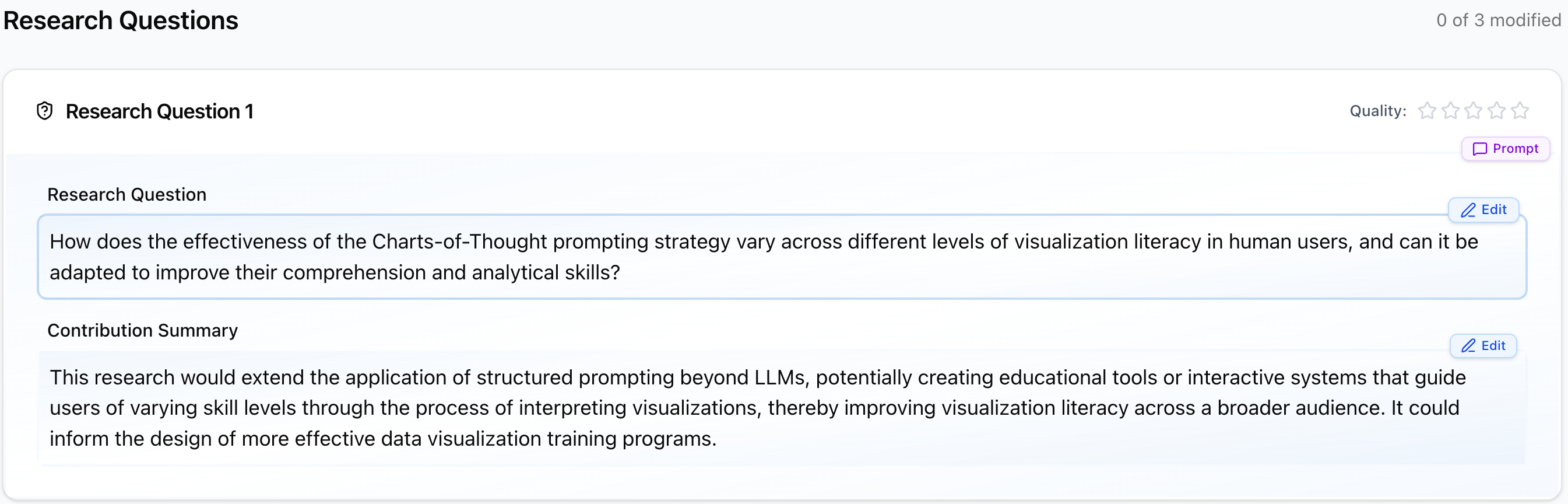
Inline edit of the generated question; every change is captured with provenance and edit distance.
Backup · Prompt-based regeneration
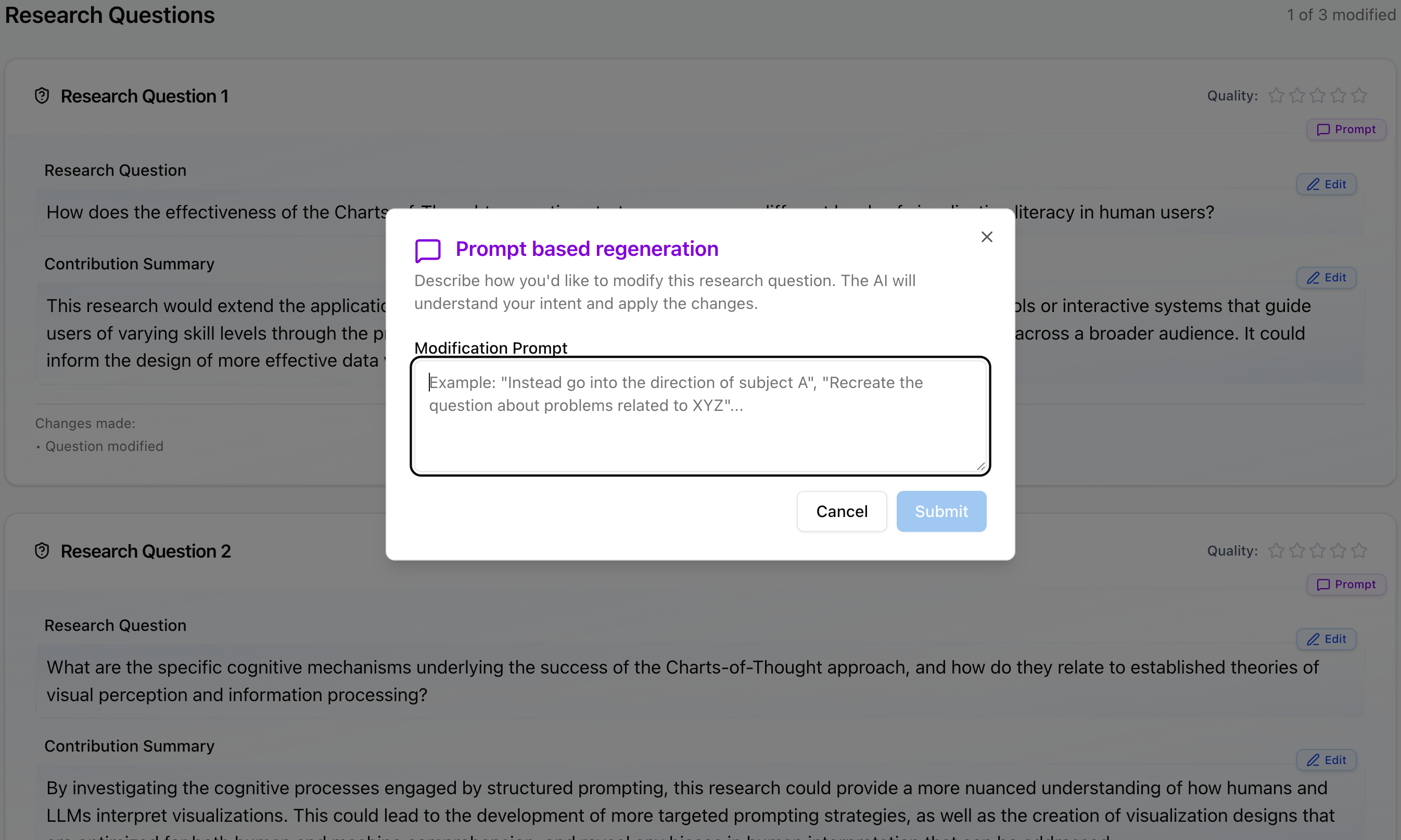
A natural-language modification prompt regenerates the artifact; the intent behind the change becomes a learning signal.
Demo: Knowledge Extraction
One edit, one lesson: the system writes down what the correction taught it.
“…how does geometric zoom
semantic zoom affect comprehension…”
In this domain, “semantic zoom” is the precise term — not “geometric zoom”.
Context-Mediated Domain Adaptation:
Every edit is implicit domain knowledge. The artifact
and the system's context evolve together, and converge.
- Capture what the user changes in the artifact
- Extract the domain knowledge behind those edits
- Propagate it back as context for the next generation
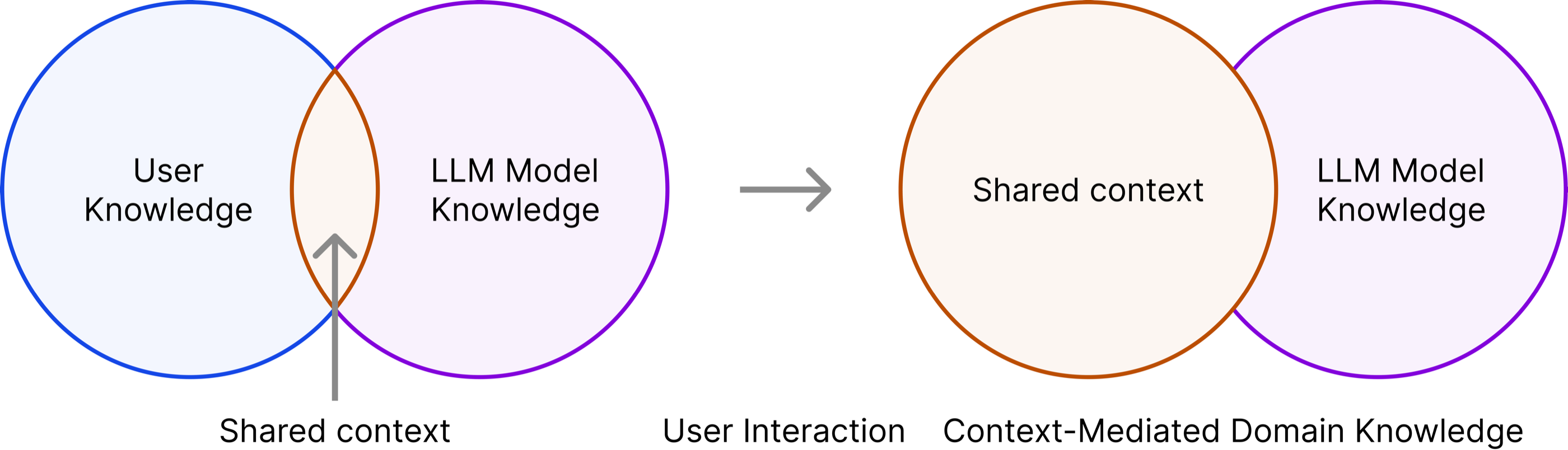
Architecture
A portable, domain-agnostic loop, accumulated knowledge kept steerable.
Deterministic edit measurement
The learning loop is only as trustworthy as the signal feeding: every edit is measured deterministically so knowledge extraction and our evaluation rest on auditable numbers.
Evaluation
Five visualization-literacy experts sequentially refined AI-generated research questions across three papers inheriting the knowledge accumulated.
Future work
-
Connect further domains
Medical literature, code, …
-
Let users interact with the knowledge itself
What should experts see of what the system has learned and how do they inspect, curate, and correct it?
-
Scale up knowledge management
Orchestrate knowledge between users, and evaluate the format itself against emerging open standards e.g. Google’s Open Knowledge Format, 2026
Thank you
Context-mediated domain adaptation in multi-agent sensemaking systems
- Edits are specifications: expert corrections carry tacit domain knowledge
- Capture → extract → inject: CMDA turns edits into an inspectable Adaptive Context Object
- Knowledge persists: it transfers across sessions and users, beyond a single chat
- It already (probably) worked: 46 entries from five experts; quality up, time down
This work was supported partly by Villum Investigator grant VL-54492 by Villum Fonden. Any opinions, findings, and conclusions expressed in this material are those of the authors and do not necessarily reflect the views of the funding agency.
Grounding in the literature
Context-mediated behavior
Agents adapt their reasoning to the situation by carrying explicit context, not just fixed rules.
Turner 1998
Explicit-context agents
Separating context from skills lets agents generalize to new situations and learn more robustly.
Munguía-Galeano et al. 2023
- Latent preference from edits · infer what a user wants from how they edit (CIPHER) [Gao et al. 2024]
- Coactive learning for LLMs · every edit is a preference signal [Tucker et al. 2024]
- Persistent memory & user profiles · long-term personalization of LLM agents [Westhäußer et al. 2025]
- Personalized agent frameworks · foundations & evaluation surveys [Xu et al. 2026]
Still distinct to Seedentia: adaptation at the artifact level, interpretable knowledge you can inspect and edit, and cross-user transfer, not per-user model tuning.